http://www.theatlantic.com/international/archive/2014/06/isis-iraq-twitter-social-media-strategy/372856/
Summary:
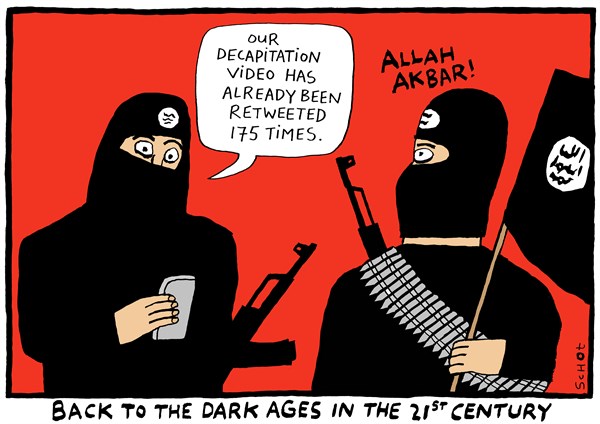
The war front of the 21st century has transformed, moving from just the battlefield to social media. ISIS has become increasingly involved in social media to raise funds, recruit, and even just to manipulate how people on social media view certain topics. However, their increasing social media support may not be as intimidating as it seems. Although ISIS does have substantial supporters on social media, many of the online "supporters" may not be as fervent as they seem.
One of these strategies includes a Twitter app called The Dawn of Glad Tidings. Upon first inspection, people assume that it's just a way to keep up with new information on ISIS. It asks for a decent amount of personal information, but it also posts tweets to your account. They have posted up to 40,000 tweets a day. The tweet themes range from violence to simple support messages for ISIS. Twitter can't detect it through its spam detection because it posts these images, videos, and messages sporadically. The app also organizes hashtag trends to persuade people to support their group. It is able to both "project strength and promote engagement online", allowing discussion and involvement from all around the world.
Question:
Does the illusion of support on social media really impact how leaders form their foreign policy? Is social media a reliable source of people's opinion? Should it be?

The media is undeniably a strong influencing force on people, especially politicians. The media gets to decided what the general public sees. The media also greatly influences politicians and their foreign policy. For example, the media shows the great horrors in Paris and that is influencing every in the United States to rally and help Paris. Because the media morph people's influences, it is not a good source of opinion. The media, in a way, makes people's opinions for them and thus alters people's true opinions.
ReplyDeleteThe illusion of social media accepting and promoting the actions of a villainous terrorist community, isn't helping the prevention of the cause to stop the insane ideas of the group. Social media needs to be used against the group similar to how the new group known as Anonymous uses it to fight ISIS.
ReplyDeleteAlthough social media is how most of the world now receives the newest information, people understand that the news is always bias and influenced by what's trending when deciding what to discuss and what seems to be the most popular and relevant. This makes the media an undeniable source of public opinion that is very few if ever accurate as well as being unreliable. Social media shouldn't be taken for the value of its content, but rather as a means to be informed on the latest topics with an open end to how the audience should make their own opinions. Groups such as Anonymous should be used more for their ability to influence how people decide to act on a situation, not inform people on what's happening based on a one sided point of view.
ReplyDeleteSocial media accounts run by and supporting ISIS do not have any significance outside of the fact that they are making a concerted effort to recruit young muslims all over the world. Most of these "opinions" on twitter is simply propaganda designed to persuade adolescent muslims of the attractiveness of the caliphate. Governments should be aware of this and make efforts to counteract it. However, in terms of directly blocking such messages, it is a bit of a grey area because of first amendment laws. However this has not stopped groups like anonymous from deleting many ISIS accounts.
ReplyDeleteSocial media definitely has a strong influence on the world. It is a way for people to share what they are thinking, and people listen. An app taking over people's twitter's en masse is incredibly dangerous on both a personal and global level.
ReplyDeleteWhile these posts may seem like a hoax initially, at some point these social media users gave ISIS permission to post from their accounts, suggesting at least a certain amount of support. It is no secret that ISIS is gaining members at an exponential rate, and no matter whether the tweets etc are valid, their perceived validity will only aid ISIS in attracting more members.
ReplyDeleteI think that social media should change how leaders do foreign policy, many young kids are very influential and they can be influenced to join ISIS through social media. This should make leaders think about foreign policy and how they treat the youth in their countries. Social media clouds the judgment of people and how they perceive things, tweets could potentially gain them more followers.
ReplyDeleteI see social media as one of the gauges of public opinion but only to a certain extent. Many people on social media think of themselves as anonymous and almost invincible. As a result, people are not always expressing their true opinions and can be saying anything that they believe is funny at the time.
ReplyDelete